What the Main Portal is
The Main Portal is what the paying customer logs into. It’s the operating system itself: Products, Manufacturers, Clients, Orders, Production, Shipments, Finance, Documents, Tasks, Dashboard, Notifications, Search, Settings, Communications, Intelligence Feed, Predictive AI, Strategic Management, Professional Services AI, Automation, Data Sovereignty. Twenty sections covering everything from quoting a deal to closing the books on it.
Reference implementation
The Main Portal is also the reference implementation of the platform. The four external portals (Supplier, Client, Logistics, Financier) are scoped, permissioned, and operator-branded derivatives of the Main Portal. They show the same data the operator owns, filtered to what each external party is allowed to see and do. The Main Portal is where new sections are built first, where new operational patterns are validated against real trade flow, and where the canonical data model the rest of the platform builds on lives.
Tasks: the nervous system
Inside the Main Portal sits one section that is doing more work than every other section combined: Tasks. Every interaction from one part of the system to another becomes a task. Every thing that needs to happen becomes a task. Supplier acceptances flow in from the Supplier Portal as tasks. Client spec changes flow in from the Client Portal as tasks. Logistics bookings, customs filings, QC scheduling, financier alerts, Atlas predictions, on-chain milestone PASS events: all of them land in the operator’s task feed.
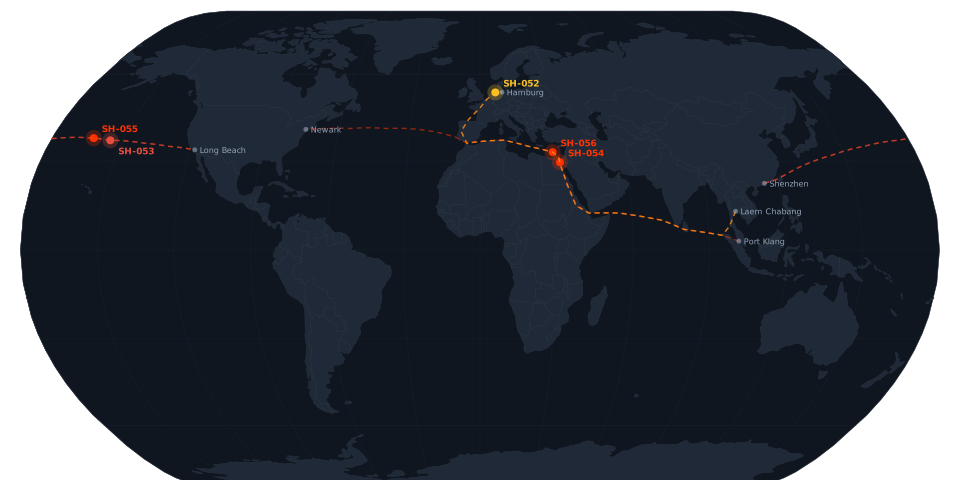
Tasks are not a sidebar to the work. They are the work. There is no other channel for cross-portal communication; every message and every action becomes a hashed, attestor-signed task with a clear source, owner, due date, and outcome. When Klang Industries accepts PO-2901 with a $0.02/unit price revision, the operator does not get a Slack message; they get TSK-1246 with the supplier portal as source, Maria L. as assignee, and a clear approve-or-counter decision. When Atlas detects a 3-day delivery risk on SH-2842, it does not send an email; it creates TSK-1247 with the AI as source, Vio as assignee, and an accept-or-override resolution.
This is the architectural payoff of building one system instead of fifteen. Every action has provenance. Every decision has an owner. Every cross-team handoff is auditable. The same data model that produces operational signals for the Marketplace, evidence packs for Settlement, and PoV inputs for the rail also produces an unbroken record of who decided what and when. The nervous system isn’t a metaphor; it is the data structure.
Six internal roles
Six internal roles share the platform. Each role sees a tailored view of the same data, with permissions enforced at the service layer (not in the UI). Same database, different lenses.
The six roles in detail
Admin
System-wide configuration. Tenant settings, user provisioning, role definitions, integration credentials, billing. The role that holds the keys to the kingdom and is therefore the most carefully audited.
Manager
Cross-team oversight. Pipeline-to-shipment visibility across every active deal. The view that surfaces OKR slippage, capacity risk, and exception flow before they become problems.
Ops
Day-to-day execution. Production status, capacity allocation, shipments in-transit, customs filings, exception handling. The role that runs the trade flow minute-to-minute.
Sales
Client-facing pipeline. Quotes, opportunities, won/lost deal tracking, commission calculation, client engagement history. A sales lens that knows what’s shipping when, not just what’s closing.
Finance and accounting
Books, payments, reconciliation, aging receivables, multi-currency exposure, LC structures, factoring relationships. The role where the operator’s financial truth lives.
Legal and compliance
Contracts, sanctions screening, audit logs, regulatory filings, dispute resolution, jurisdictional sensitivity. The role that protects the operator from legal and regulatory exposure across every counterparty and every corridor.
Where it stands today
The Main Portal is in production. Stage 1 of the EDMA roadmap (Mar–Jul 2026) is the Trade OS Platform build, currently 80% complete. Closed beta opens on May 18, 2026 with 50 beta customers; public launch follows on August 1, 2026 as Stage 1 transitions to Stage 2. Thirteen MVP sections ship at public launch covering the operational core, search and settings, plus Professional Services AI. Automation and Bots ships in MVP as section fourteen. The remaining six sections ship through Q4 2026 and Q1 2027 in parallel with the L2 mainnet and Global Trade Marketplace launch.
Pricing and trial access live at edma.trade. Full roadmap at /roadmap/.