A mind, an engine, and a third pillar.
For eight releases we built the trade itself — the desk that runs it and the four counterparties around it. This release is four moves at once. Trade OS crossed from working software into a platform with a mind of its own. Growyn went from an introduction to a running engine, section by section — including a video studio that writes, voices, and cuts. The rail has its audits signed, its purchase flow on Ethereum mainnet, and its testnet date locked. And a third pillar enters the build: Flowyn.
The sequencing principle holds. Trade OS proves the OS, the OS proves the rail, the rail proves the marketplaces. Everything below runs on real operations — not a demo, not a deck.
Part 1 — Trade OS: the platform, portal by portal.
Trade OS holds the entire trade lifecycle as one connected record — products, manufacturers, clients, orders, production, shipments, finance, documents — with an event-driven double-entry ledger wired underneath, so landed cost and margin are live per order, not reconstructed at quarter end. Every counterparty portal is a scoped window into that same record: nobody gets a copy, everybody gets their view.
It runs in production at EDMA Group today — $80M of trade revenue across 12 supplier factories and 8 destination markets. The features exist because the operation needed them, not because a product team drew them. What is left before public v1 is verification on mobile and end-to-end testing.
One order, every seat at the table.
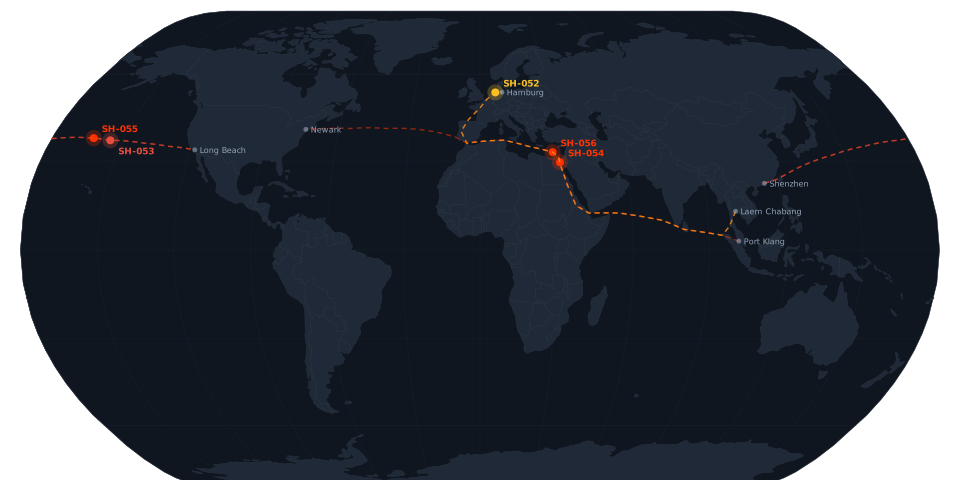
One order ripples outward: the operator confirms it, the supplier sees a purchase order, production milestones flow back, the forwarder’s shipment updates the client’s tracking, the invoice reaches the client, and — if financed — the financier’s agreement settles against the same record. Counterparties join by magic-link invitation with entity-scoped permissions; every portal sees the same truth, redacted to its role.
The privacy holds at the data layer, not the interface. Clients never see the factory, the operator’s cost, or the margin. Suppliers never see the final buyer or the resale price. Logistics moves the cargo without touching the money. The boundaries are enforced at the route, query, and event level.
The financier seat is now working software.
In #8 this was fifteen screens of design. It is now built, and the fifth seat is occupied. A financier registers and passes vetting self-serve — sanctions screening included — then works a desk built around disclosure as architecture: published receivables appear summary-only by default, and full detail opens only after an explicit disclosure handshake granted by the operator.
From there: compose an offer, track it to a decision, and manage the agreement from pending-legal through active to settled. Deals sourced outside the platform enter through a guided wizard and land in the same book, so the portfolio view — capital deployed, yield, repayment behavior, concentration — covers everything.
One documents engine, five lawful views.
Trade runs on paper, so the paper became one system. Upload anything and intake intelligence reads it — OCR, extracted fields you accept or correct, full-text search across the archive. Documents generate themselves from live order and shipment data. A real editor sits on top: e-signatures with saved libraries and certified copies, version history and compare, comments, watermarks, audit trails, and secure expiring links for anything that leaves the platform.
Operator, supplier, client, logistics, and financier each render the same document through their own scoped route — one source, five lawful views.
The mind: Atlas, the Brain, and Professional Services.
Atlas is the platform’s agent — ambient across every portal with a command bar, a needs-you queue, and a handled feed. It watches the business on schedule — stalled orders, overdue shipments and invoices, expiring certificates, stock levels, margins, client health — and raises signals before you go looking. It acts through gated tools: propose, approve, done. Every specialist sits on a trust ladder you set per capability; Watching structurally blocks action. For counterparties not yet on the platform, Atlas does the chasing on your behalf — parsing email and WhatsApp replies and writing them back into the order — and its role shrinks as more partners come in.
The Brain grounds it: a prediction ledger with a visible track record including the misses, calibrated facts learned from your own operation, and trusted context injected into every AI answer so nothing is invented.
Professional Services AI does the work you’d send out: contract analysis with confidence scored by the platform rather than the model’s self-report, contract drafting with a clause library built from your own agreements, accounting categorization grounded in your chart of accounts, and P&L, balance-sheet, and cash-flow commentary on the live ledger — the full three-statement set, exportable.
Automation with a safety system, and the platform run as a business.
Bot Studio ships in guided and manual modes with a library of outcome-named helpers you add in one click, and dry-run previews that show what a helper would do before it touches anything. Underneath: retries with backoff, error-rate auto-pause, priority rules between conflicting workflows, rate limits on bulk triggers, and circuit breakers on workflow cascades.
And the platform runs as a business: tenant management with suspension enforced across every portal, impersonation with full transparency and instant revocation, versioned pricing with subscriptions, invoicing, refunds, credits and dunning, GDPR tooling and legal holds, and a full audit surface — with two-admin release and re-authentication on sensitive actions.
Part 2 — Growyn: the engine, section by section.
In #8, Growyn was an introduction. Since then the suite went from designed screens to working sections across the whole loop. Here is the engine, section by section — pre-launch, on a doors-open track.
Intelligence — the research department.
The starting point: a multi-step research pipeline with live web search that produces the full strategic picture — market, audience, competition, demand, pain points, pricing, brand, channels, SWOT, tradeoffs, validation, synthesis — as living sections rather than a PDF dump, with a confidence layer that says how sure each claim is, and a whitepaper generator for the businesses that need one. Industry packs adapt the entire run to the business detected — a blockchain launch and a local business get different channels, deliverables, and compliance out of the same pipeline. Re-runs version cleanly.
Funnel Plan — the marketing brain.
Where the whole plan lives: a milestone-gated hub, a Funnel Builder that models stages, channels, conversion estimates and budget — with real ARPU sourced from actual pricing, transparent reach sources, and what-if scenarios — and a long-form exportable Full Plan. The plan is not decoration: it issues directives the other sections consume, and their results report back against it, real-versus-expected per stage. Locked plans version.
Website — generate it, or bring your own.
Two paths. Growyn generates a site — five-stage AI generation, block editor, blog, theming from the brand kit, SEO and tracking wired in, publish to hosting. Or point it at the site you already have: the imported-website editor connects to a GitHub repository and you edit visually — the agent sees exactly what you selected, small visual edits apply instantly through a deterministic parser, bigger ones route through the model, and everything ships as a pull request you approve. A second, bespoke generation engine produces hand-written-grade multi-page sites with populated product mocks and engineered diagrams.
Here is a marketing video the studio produced end to end — the clearest demo of what Growyn does once the plan, brand, and content engine are wired together.
Content — the newsroom.
The week plans itself: "Generate my week" decides channels, pillars and cadence from the plan, writes everything, scores every piece, and runs a deterministic number-audit so no unverified statistic ships. Around it: a calendar with month and week views, a library that holds every asset including video, a review queue, and revenue attribution down to the piece through the shortlink engine. Publishing connectors are rolling out.
The Creative Studio.
One conversational pattern across writing, images, and video: a Creative Session where the work is debated before money is spent — concept before spend — grounded in what the Brain knows about the business, with every paid generation kept as a variant you can return to.
The video studio.
A full production pipeline on Growyn's own stack. Storyboards written under explicit story-logic laws — one meaning per symbol, lines true to their frames, briefs limited to what a camera photographs in one frame. A professional full-page editor with scene lanes, per-scene directed voiceover, and punch captions timed word-by-word to speech. Characters speak with lip-sync on our own model queue — no avatar SaaS. A talking-head lane for real founder footage. Sound effects and a built-in music library. And film grammar in the render: sound bridges, cuts on motion, dissolves reserved for time jumps.
SERIES — episodic content as a product.
New this release. Each customer runs a weekly stylized series starring their recurring cast, written by the engine from their real audience research. A series bible, a writers' room that generates whole seasons behind an approval gate, an episode engine, fixed voices per character with lip-synced dialogue, photo-form episodes — carousels, comics, banded slides — covers baked as frame one, teaser, quote and poll derivatives mined between drops, and per-series measurement. Story-shaped, not sales-shaped: the product is a prop in the world; the season arc carries the transformation.
SEO — an engine, not an audit tab.
A continuously updated keyword map fed by Intelligence demand signals and enriched with volume, difficulty, and trend; Search Console tells it what you already rank for and what is moving. A research-grounded article writer produces evidence-cited pieces that link only to pages that actually exist, and an autopilot plans and writes on a cadence you set — draft or auto-publish, to your Growyn site or WordPress, Webflow, Shopify, Ghost, Wix. Site audit, backlinks, and visibility tracking round it out.
Paid Ads — the budget optimizer.
A creation flow that takes a campaign from type to format to creative to launch, across mainstream and crypto-native channels — Google, Meta, LinkedIn, TikTok, Reddit, YouTube, X, plus CoinTraffic, CoinZilla, BitMedia, and Brave. The overview is a budget optimizer with three honest states: cold — no data yet, so it shows the plan, not results; warm — campaigns live but under seven days, so real numbers, no advice yet; live — recommendations and money moves. Scale, reduce, hold and pause calls are a deterministic rules pass over CPA, ROAS, target, and trend; every estimate carries its provenance. Boost turns winning organic content into spend.
Capture — traffic into contacts.
Four asset types — forms, popups, lead magnets, surveys — plus polls, meeting booking with routing rules, and progressive profiling for return visitors. The visitor side is a pure-code pipeline: rate-limited, email-validated, disposable-domain-blocked submissions fan out to the contact database, attribution, and nurture enrollment in one motion. The creation side drafts with AI grounded in the Brain, and the autopilot fills the gaps the funnel plan identifies — in Automated mode it publishes with undo.
Nurture — journeys that run on clockwork.
An email system with a visual journey builder where the clock and the branching are pure logic — AI writes the emails; it never runs a journey. Contacts enter by form, event, segment, or hand; re-entry is governed by cooldowns and caps; send policies enforce daily caps and quiet hours; suppressions and consent gate every send through an idempotent ledger. Segments, scoring rules, templates, sending domains, imports, and reports complete it.
Engage — every conversation in one inbox.
One channel-agnostic conversation model behind every surface. The website chat widget runs the full loop — visitor message, AI auto-reply, human handoff with suggested responses. Bot Studio builds the personas, with a test sandbox. Community management runs on Telegram with rules-based moderation in review-only mode; reviews are captured with AI-drafted responses; insights show volume, sentiment, response coverage, and community health. Channels are expanding.
Close — the CRM.
Nine surfaces on a shared engine: pipelines with drag-and-drop kanban and rot and hot flags, companies and contacts with 360 views and account heatmaps, prospecting as a live work queue, campaigns with A/B testing and precise per-campaign attribution, activities fed by sequence-created tasks, sales sequences on the same consent-gated engine as Nurture, deterministic lead scoring, revenue KPIs computed server-side — nothing AI-invented — and a workspace with a live brief, next-best-actions, and Ask.
Analyze — the truth layer.
Overview, channels, funnel, visitors, reports, and a translator that turns analytics into plain language. The mode model is honest by construction: empty, simulated, live, and projected states are labeled as exactly that; ROAS shows a dash rather than a fabricated zero when no ad platform is connected; no intermediate funnel stage ever gets an invented actual. Reports generate against an honesty contract and share through revocable public links.
Optimize — the weekly discipline.
Scheduled workers detect patterns, propose actions with expected impact, measure outcomes after a window, and write the Monday brief. Auto-apply is governed by the operating mode, and every action lands in a ledger with its result — so the system's advice has a track record you can check.
Assets and the ContentDNA library.
Brand kit — logo, fonts, colors, kit health — media with auto-tagging, templates, and exports. And ContentDNA: the reusable hooks, frameworks, CTAs, and topics Growyn extracts from analyzed content and feeds back into everything it generates.
The platform layer: one Brain, three modes, one inbox.
Every AI generation in every section routes through one shared Brain — a single context-assembly entry point that injects what the whole system has learned into each task, with per-run cost accounting on every piece of work the platform produces. Operating modes — Manual, AI-Assisted, Automated — are a platform primitive: each section can propose, draft for approval, or act with undo. Everything pending lands in one approvals inbox. First-party tracking and conversion definitions run through the Spine; the data hub syncs connectors on schedule; billing meters credits against real usage.
growyn.app.
The public site is live at growyn.app.
Part 3 — The rail: audited, dated, and taking purchases on mainnet.
The contract suite — PoV Gate, One-Claim Ledger, attestor registry, EDSD, EMT, settlement controller, fee router, burner — stands deployed on testnet with both security audits signed. The $EDM purchase flow now runs on Ethereum mainnet with live pricing.
Public testnet opens August 20 with attestor onboarding; mainnet promotion follows in Q4 2026.
Part 4 — Introducing Flowyn.
The third pillar, alongside Trade OS and Growyn: Flowyn — the operating system a renewable energy project runs on across its whole life, from the first secured site to a thirty-year-old asset being sold. A renewable project is not a product; it is a years-long agreement among a crowd — a bank lending most of the capital, equity investors, an EPC that builds it, an O&M provider, an offtaker, advisors, a grid operator, an insurer. Today the owner is the human integration layer between them, re-assembling the project's state by hand from a finance model in Excel, a SCADA portal, a bank account, a data room, and email. Flowyn replaces that with one shared, verifiable record.
One event-sourced record carries the whole project — every fact an append-only event, everything tagged to the project itself — and the lifecycle is the spine: Development, Financing, Construction, Operation, Exit — thirty-five years on one continuous record, nothing lost at the seams. The holder sits in the cockpit and supervises through an approval loop; every other party — lender, investor, EPC and O&M, offtaker, advisor, authority, and a portfolio lens for the banks that finance many projects at once — gets a scoped window onto that same record, never a copy. Disclosure is a dial, not a handoff.
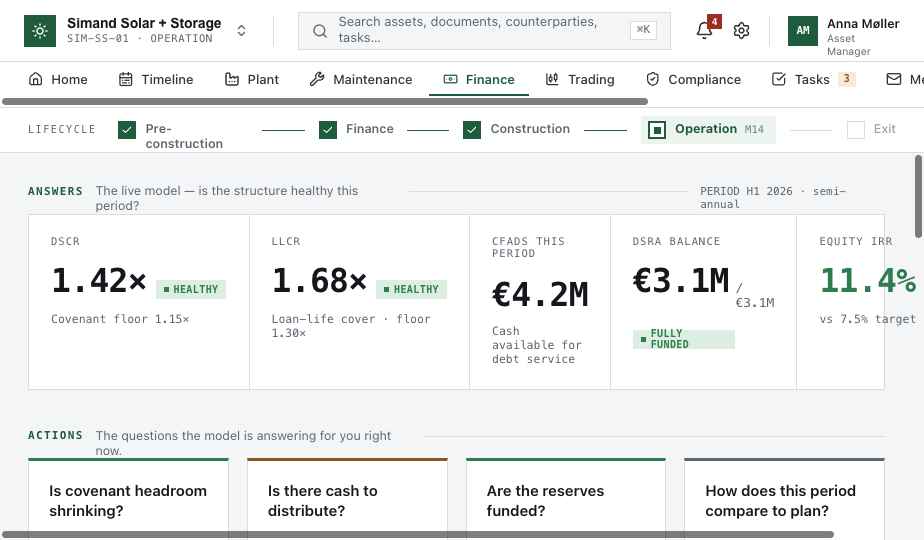
At the centre is a deterministic financial model — seeded from the real project-finance model and recalculating continuously from actuals instead of a human pressing a macro. Generation, revenue, and capital maintenance flow in; CFADS, DSCR against its 1.15x covenant floor, LLCR, the cash waterfall, the debt-service and major-maintenance reserves, and equity IRR against target flow out. Five domain agents keep each answer current and propose the next move — CFO for finance, Ops for production, Asset for maintenance, Trading for sales, ESG for compliance — but the boundary is strict: the engines compute the numbers, the agents explain and propose, the holder approves anything consequential, each agent set on an autonomy ladder from monitor to recommend to approve-to-execute.
The result is that nothing consequential arrives unseen or unfunded: an inverter replacement is flagged years ahead off the component clock, the reserve has been accruing toward it since financial close, and when it comes due the holder approves and the money is already there. It is the Trade OS answer pointed at energy — one record, live scoped windows, verifiable truth — grounded in a real 237 MWp solar-plus-storage reference asset (≈€159M enterprise value) whose project-finance model becomes the system's schema. Flowyn is at blueprint: the architecture, the design language, and the cockpit and module specs are written; the build starts now.
What this adds up to.
Eight releases built the trade. This one gave the platform a mind — an agent that watches, proposes, and acts under your control; professional-grade legal, accounting, and reporting on your own data; a marketing engine that produces finished work, section by section; and a third pillar entering the build with a lender-grade ledger at its core. The rail underneath is audited and dated.
Verify first. Then mint.